Thursday, January 15, 2009
Strawberry Corn/
I was in a local store sometime in December, and picked up some dried strawberry corn ears. They are red and shaped sort of like strawberries, and were right next to the Indian corn. What exactly the heck is "Indian" corn, as opposed to sweet corn or field corn? I suppose that the tricolor ears of dried corn were all that the poor natives could grow, having no giant factory farms to do all of the work of sorting all of the colors out in each ear. (You may detect a small amount of facetiousness here) Hybrid corn is one thing, but to call a particular strain of mutt corn Indian corn is a bit misleading. All corn started out as Indian corn. Native American corn. Actually, and most probably South American Indian corn. There is evidence that corn was adapted to almost every environment on both Americas. There are heritage varieties that have more protein and less sugar than current corns, whose genetics are owned by Monsanto or ADM or some other world farming and seed conglomerate. These older and less manipulated corns may be better food stock than the newer ones, but aren't they grown commercially? Too much manual labor. Not easy to convert to harvest by machine. Too short. Not enough product per plant.


Tuesday, January 6, 2009
Back in Business
Sorry for the extended delay in posting. I've had some issues with different things, but am now back at the keyboard. I have several interesting stories to relate, and some new topics to bring to you. I post again later this week.
Until then, be indigenous to where you are.
Until then, be indigenous to where you are.
Tuesday, September 2, 2008
We are not Immigrants!!!
We are not a nation of entirely immigrants. Some of our ancestors were here before wholesale immgration to the western hemisphere began. If my ancestors crossed the "Ice Bridge" then they were the ORIGINAL settlers of this continent. Meaning in the usual eurocentric traditions the newer mmigrants moved onto land owned and deeded to people ALREADY living there. Furthermore, because my forebears couldn't lay hand to their copy of the deed (which incedentally, I'm sure was under a pile of hides in the corner of the wigwam, tipi or longhouse at the time) we have beenconstantly losing ground to a culture that has overwhelmed us by sheer numbers. If the hispanic population continues as projected, newer immigrants will outstrip the "grand old families" of immigrants. What will the "grand old families" have to say when someone moves into theri old digs? Oh, I just remembered the "right to bear arms clause! How convenient.
Once the vast resources of this continent are depleted, where will these guys emigrate to? South America? What about after the planet's eventual depletion at the current rate? Then the moon? Mars? Maybe there is OIL there, or some other easily exploited power source.
I realize I give no answers to all of this. I think the answer has to start with all of us, rich, poor, middle class, Foreign and Domestic, weird and plain to start putting our resources to the most important of our current and pressing needs as stated by a native long ago: Let us prepare for the Seventh Generation unborn.
'nuff for today
Shey Hoy
Once the vast resources of this continent are depleted, where will these guys emigrate to? South America? What about after the planet's eventual depletion at the current rate? Then the moon? Mars? Maybe there is OIL there, or some other easily exploited power source.
I realize I give no answers to all of this. I think the answer has to start with all of us, rich, poor, middle class, Foreign and Domestic, weird and plain to start putting our resources to the most important of our current and pressing needs as stated by a native long ago: Let us prepare for the Seventh Generation unborn.
'nuff for today
Shey Hoy
Tuesday, August 26, 2008
Tiny Houses. A great Concept!
I was surfing the other day, and you know how serendipitous things can be, this popper up and I thought it was something worth comment. Have you heard about tiny houses? Check out this link Tiny House and see what I'm talking about. It's pretty interesting to see how people are living in a minimum of space. Pretty radical thought in America, land of the 250,000 sq ft home. Very needed in the battle we need to realistically start on sustainability. What is the minimum space you could live in? I think with the right setup, I could live in about 140 to 150 square feet. My family would not be as happy in such a small space. Currently we have about 1200 square feet and it seems no one has any space. In the Orient, people are used to living in small spaces, and do just fine. Probably what you get used to. I was listening to Montana Public Radio the other day, and this man was trying to get people to believe that we need to quit building on farmland and create communities that are more densely populated and utilizing what we have more efficiently. Allowing people (all people, especially poor ones) access to land that they can use to farm and produce their own foods. Bring back the craftsman, and small farmers and becoming locavores. Teaching people to can and put up their own foods, and thus stopping hunger. Putting people back to work doing all sorts of work that was taken away by machines. Paying people a fair price for their goods, and receiving fair value for our own labors. Pretty much the opposite of what we have now. I have come across this thinking before, here at Dave Pollard's site. This particular blog helps to understand why things are the way they are, and although it will be a tough road to change that, we will start having to move in the direction these people are moving. Poor people eat junk food because it's cheap and bad for you. Hence, they are more likely to have serious health problems. Health problems shorten and decrease quality of life, as well as cost extra at health insurance time, causing less money to be available for nutritious food, so you can only buy cheap, bad food, and then if that's not enough, it is perpetuated in the next generation because they know nothing else. An unsustainable cycle. sooner or later there will not be enough workers to do the labor required to keep the bourgeoisie in the manner in which they have become accustomed to. A veritable house of cards with lives as the supports. Insanity.
Done ranting for today, Shey Hoy
Done ranting for today, Shey Hoy
Tuesday, August 19, 2008
Painting Part 2


I said earlier I was painting, and this is the
series from the last week. i am using a watercolor notebook made by Moleskine. the first two look pretty bad, as far as I'm concerned. the clouds are lackluster and boring. The clouds in the second look like a crippled plesiosaur.

The First one is a hazy day here in the valley, the second is after I watched an eight minute You Tube video, and got some good ideas and came up with something pretty good, by my standards.

I have one last picture to show off, and that is the sort of southwest thing I managed to paint while my son was swimming for an hour at home. I did watch him swim, and paid attention to him, I was within 16 feet from him at all times. And the pool is only 2 1/2 feet deep.
 I think it is a good thing to look at the way light works in watercolor paintings, because most of the paint is transparent, a great discussion of Lambert-Beers law and the interaction of light and matter can take place. One other thing I will mention is that I watched a video from Micheal Wilcox about mixing blue and yellow not making green and recieved some of the best scientific and artistic information on color theory ever. After looking at that and changing my paints somewht, I now usually can mix exactly what I want. It really is a pretty good system. And one of these days, I will break down and buy a set of those paints, instead of havng to make do with others. Who says Art and Science don't make a good pair? Shey Hoy. (by the way, I had a few formatting problems, so I hope this get out OK.)
Wednesday, August 13, 2008
Painting
I'm painting again, which is to say I've picked up and dusted off my paintbrush again in artistic endeavor. As I mentioned last week, I have picked up a new notebook, and found my watercolors (field set and crayons) and set my hand to page. Such as it is. I have always wanted to be able to draw and paint lifelike portraits and deeper than deep realistic landscapes. So far, that sort of thing is beyond me, but I keep trying. Maybe when I'm 80 or so I'll get good at that sort of thing. I paint some abstract and symbolic things now, and people tell me they like them, but you can never tell. Maybe I need to actually buy frames for the art so it looks like I'm a real artist. My art friends tell me that I really should paint more, I guess because they think I might have some talent. I have listened to them, because they would know, and they tell me the truth for the most part. Things like I'm good looking and make beautiful jewelry. I love to paint with acrylics, I like the ability to add texture and wild colors like the photo below. 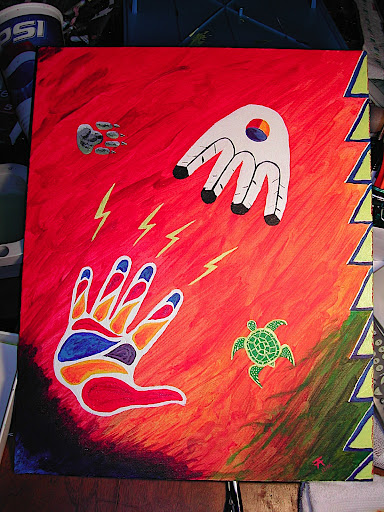
I call this "Formed v. Unformed" and there are a lot of details involved that I won't go into here, just take a look and tell me your opinion, should I keep on painting or hang it up? ;)
I call this "Formed v. Unformed" and there are a lot of details involved that I won't go into here, just take a look and tell me your opinion, should I keep on painting or hang it up? ;)
Wednesday, August 6, 2008
Curriculum Development, Pt 1
I have been away working on a curriculum project I'm on in Fort Collins, Colorado. With all of the other things I do, this has been pushed to the back burner for the last couple of months. To all of the people I work with on that project, I apologize. Making new things and trying to not use old things is a difficult task at best. Original thinking is a a premium these days, and highly underrated. In the political arena, the scientific area, education, agriculture, automobile, all are suffering from the "in a rut" syndrome. Any new thinking is maybe being held off until after the Presidential elections, or the New Year or some other regime change. My new thinking has been held off due to family matters, but at least I have a weak excuse. Native science has been in full force with me, and writing has been cast aside. I really don't enjoy writing sometimes, but I also feel that if I totally stop, my ideas will languish and die. The thought itself will continue, but the record of it's progress will stop. As a constantly evolving entity, the knowledge section always is past explanation here, and I hope the crumbs and fragments of the basic ideas get through.
This is also a curriculum development activity. A written document chronicling the thought patterns of someone who walks in at least two different neighborhoods in the same city. Many natives call it living in two worlds, but as I see it, there is only one world, one place humans can call the communal home. If I went to China, or France, I would still be in this one world, but the perceptions around me would change of the same place, would they not? Do we all see the same world? I have asked this before, I think, but it is worth revisiting. Would you want to see the world through my eyes and I out of yours? Some days I think the world has gone into the proverbial hand-basket. Other days are much better. Especially days without television.
More on that later.
My newest thing are my Moleskine sketchbook and watercolor notebook. These are the best thing to come along for a while for the writer and artist. Nice lined, unlined and sized pages, great paper, variety of styles, all good stuff. Check them out.
This is also a curriculum development activity. A written document chronicling the thought patterns of someone who walks in at least two different neighborhoods in the same city. Many natives call it living in two worlds, but as I see it, there is only one world, one place humans can call the communal home. If I went to China, or France, I would still be in this one world, but the perceptions around me would change of the same place, would they not? Do we all see the same world? I have asked this before, I think, but it is worth revisiting. Would you want to see the world through my eyes and I out of yours? Some days I think the world has gone into the proverbial hand-basket. Other days are much better. Especially days without television.
More on that later.
My newest thing are my Moleskine sketchbook and watercolor notebook. These are the best thing to come along for a while for the writer and artist. Nice lined, unlined and sized pages, great paper, variety of styles, all good stuff. Check them out.
Tuesday, July 15, 2008
Folk Festival in Butte, MT
etozI was in Butte, MT this weekend as a vendor for the festival, and it was pretty interesting. There were about 60-70 thousand people that attended. I was there with my business, Salish Silver, selling silver handmade jewelry. Part of being a Renaissance Indian is keeping up with multiple arts and cultural events. I have several very good friends that are excellent artists, Valentina La Pier, a Blackfeet Indian from Browning (living in Arlee, MT) whose paintings are too great to ever pass up if you have the funds, and DG House, a Cherokee living in Bozeman, MT who has animal and native paintings and prints that are distinctly different from others. Both of these ladies I count among some of the best people I know. I also was able to talk to Leroy Whiteman, an antler carver who makes the best antler carvings I have ever seen. Merle and Nicole Big Bow from Ronan were there with their beadwork, paintings and crafts, all beautiful things. It was like old home week visiting with all of these talented artists. I'm glad that my son is able to meet and get to know these prople as well, because it shows him the value of making friends with good people. Of all the artists, DH is like a sister to me, we can see each other once a year or month or whatever, and we're always just glad to see each other. I call her about once a month to keep up with her, she travels to shows all over the western US and meets some pretty interesting people. I think we probably have 30 DG House prints at my home, and always looking for a place to cram another three or four in. It's the most awesome wallpaper you have ever seen anywhere. My artist friends always tell me to paint more, and I should, but I need to sleep sometime as well.
Wednesday, July 2, 2008
Weeks of travel
I have been a traveling man the past several weeks, I was in Challis, ID during the second week of June presenting and participating in a "Pathways to Mars" workshop. NASA and NSF provided funding for this, (I think) and there were a variety of activities. For my part I made an atlatl (AT latl) to show how it was used. People love to throw things, don't they? Projectiles are an important part of all cultures, whether or not you want to believe it or not. Hunting and protecting your family are pretty good reasons to have some sort of projectile around. The Maya used them to puncture the armor of invading Spaniards before disease weakened them to a point where it made no difference. Atlatls have been found on every continent except Antarctica.
Thursday, June 5, 2008
Symbols of the present.
Symbols seem to surround us, from traffic signs to restroom and directional arrows. We have chemical symbols, warning symbols, the hazard diamond just in my field of chemistry. What about numbers? They are symbols as well based on an Arabic decimal system from the ninth century. Think about the symbols 1,2,3,4,5,6,7,8,9,0. (remember that zero is a fairly new idea in numbers) What exactly do they mean? The first numeral system was probably tally marks. Marking one line for each counted item would have become unruly after the first hundred or so, at least very monotonous. Somewhere along the line, somebody made the decision to make another kind of mark mean some number of other marks. Revolutionary. World changing thought occurred in that instant. Something to think about. Around the same time, addition and subtraction must have been born, giving rise to mathematics. Mathematics is rife with symbols, all with their own life and system of operation. The next time you dial your cell phone, think about the symbol you have just used, as well as the status symbol you hold to make the call. Humans use symbols for many things, the list is constantly changing as well, evolving as we speak. The letters you are reading are symbols of the language that is fast becoming world-wide.
Something to think about...
Shey hoy
Something to think about...
Shey hoy
Subscribe to:
Posts (Atom)